Short answer: pick Rank Math if you want the most for free, or you run several sites of your own. Pick Yoast if you want the clearest writing guidance and the plugin every tutorial assumes. Neither one will rank a page for you. Both print the same core tags Google reads.
Key takeaways
- Free: Rank Math adds redirects, a 404 monitor and 5 focus keywords. Yoast coaches your writing better.
- Paid: Rank Math PRO (€8.99/month, billed yearly) covers every site you own. Yoast Premium is €118.80 per site.
- Switching to Rank Math moves almost everything. Going back to Yoast moves post fields only.
Most “Rank Math vs Yoast” articles are written by a competitor or an affiliate. This one uses public numbers: WordPress.org data, both plugins’ own pricing pages and source code, an independent speed test, and our own scan of which one the top 10,000 websites run. For the record, this site runs Rank Math, and we have no affiliate deal with either plugin.
Rank Math vs Yoast at a glance
| Rank Math | Yoast SEO | |
|---|---|---|
| Active installs | 4+ million | 10+ million |
| On WordPress.org since | November 2018 | October 2010 |
| Rating | 4.8 (7,507 reviews) | 4.8 (27,820 reviews) |
| One-star reviews | 2.6% | 3.0% |
| Support threads resolved (last 2 months) | 39 of 40 | 30 of 33 |
| Installed size | 15 MB, 1,337 files | 21 MB, 1,938 files |
| Redirect manager | Free | Premium |
| 404 monitor | Free | No |
| Focus keywords per post | 5 free | 1 free, 5 in Premium |
| Schema types | 16+ free | Core types free |
| Paid version | €8.99/month, billed yearly | €118.80/year |
| Sites per paid licence | Unlimited sites you own | 1 site |
Which one do big sites use?
On 29 September 2026 we scanned the homepages of the top 10,000 sites in the Tranco ranking and found 716 WordPress sites. 323 run Yoast. 74 run Rank Math. That’s more than four to one, and the ratio holds at every level of the ranking:
| Tranco rank | WordPress sites | Yoast | Rank Math |
|---|---|---|---|
| 1–1,000 | 49 | 23 | 6 |
| 1,001–2,500 | 108 | 58 | 8 |
| 2,501–5,000 | 171 | 69 | 15 |
| 5,001–10,000 | 388 | 173 | 45 |
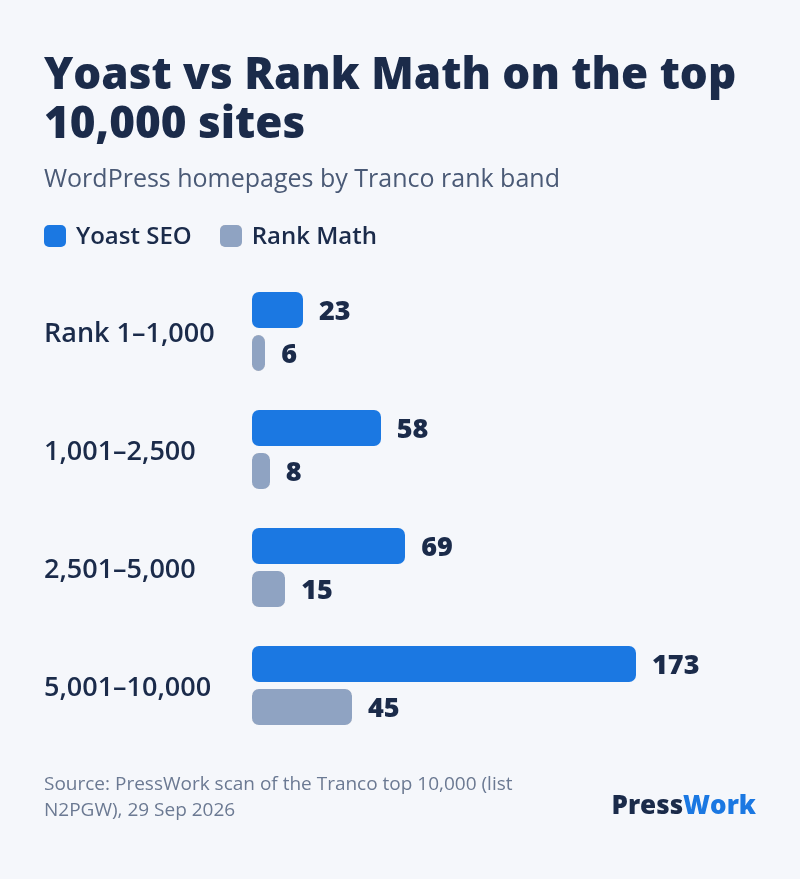
Yoast’s users include Harvard, TechCrunch, the US State Department and Creative Commons. Rank Math’s include NASA, Docker, CNET and ZDNet. So both handle very large sites. Yoast’s lead mostly shows that big sites rarely change SEO plugins once one is in place. It’s not proof that Yoast ranks better. You can check any site yourself with our plugin detector.
Free version: Rank Math gives you more
Both free versions handle the essentials: titles, meta descriptions, XML sitemaps, canonical tags, breadcrumbs, Open Graph tags and schema. The difference is what comes on top.
Rank Math free adds a redirect manager, a 404 monitor, up to 5 focus keywords per post, 16+ schema types and modules you can switch off one by one. On Yoast, redirects and extra keyphrases are Premium features. A free Yoast site needs a second plugin, such as Redirection, to handle redirects.
Yoast free is stronger on writing. Its readability checks cover sentence length, paragraph length, transition words and passive voice, with a red-orange-green light per check. Rank Math gives a single score out of 100 and focuses on keyword placement. If you want the plugin to coach your writing, Yoast does it better.
Paid version: Rank Math is cheaper beyond one site
- Rank Math PRO: €8.99 a month, billed yearly (about €108 a year), for unlimited sites you own. Client sites need the Business plan at €27.99 a month, billed yearly.
- Yoast SEO Premium: €118.80 a year, and one subscription covers one site.
For one site the prices are close. For three sites of your own, Yoast Premium costs €356.40 a year and Rank Math PRO still costs about €108. Both sell first-year discounts, so check the current offer before you buy.
Speed: close on the front end, Rank Math lighter in the admin
Accelera timed both plugins on a clean WordPress install (full test; published July 2024 with Rank Math 1.0.224 and Yoast 23.1, updated September 2026):
| Execution time | Rank Math | Yoast SEO |
|---|---|---|
| Page seen by visitors | 69 ms | 71 ms |
| Admin dashboard | 73 ms | 95 ms |
| Post editor | 96 ms | 177 ms |
| JavaScript loaded in the editor | 190 KB, 9 files | 678 KB, 30 files |
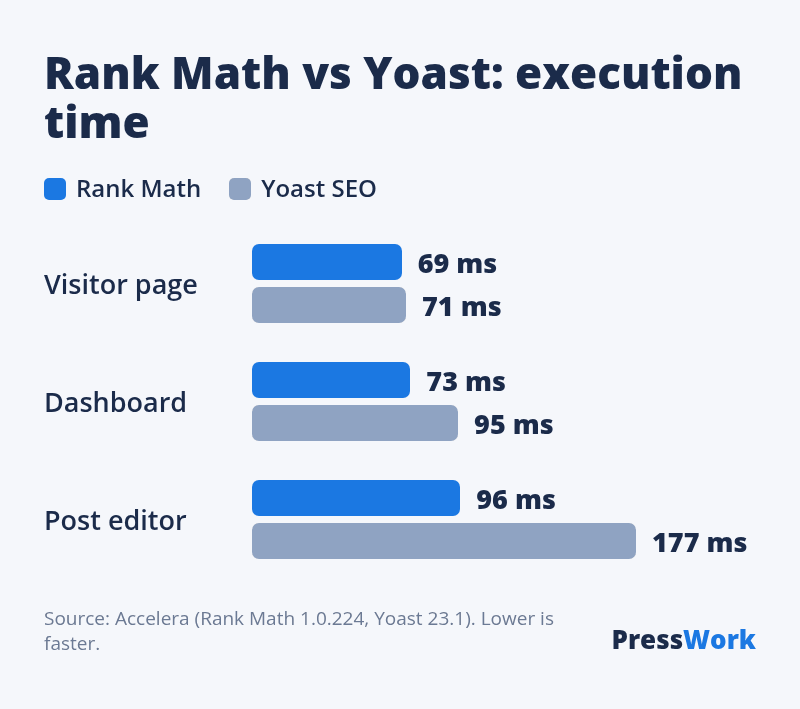
Visitors won’t notice a 2 ms difference. Writers will notice the editor: Yoast took almost twice as long to load there. If speed is your main concern, neither is the answer. The SEO Framework and Slim SEO ran two to three times faster than both in the same test.
Switching between them
Moving from Yoast to Rank Math is easy. Rank Math’s importer (Status & Tools → Import & Export) brings over Yoast’s settings, the titles, descriptions, focus keywords and robots settings of every post, category and author page, Yoast Premium’s redirects, and Yoast’s blocks. We checked this in Rank Math’s source code (version 1.0.279).
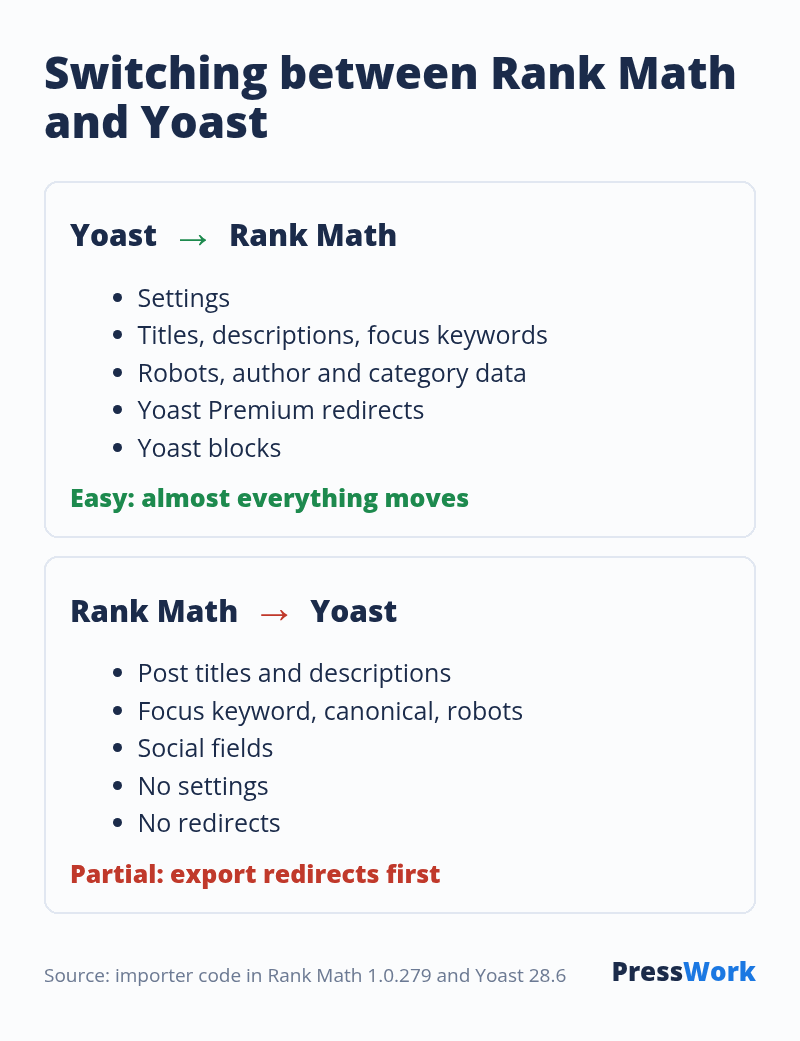
Going back is harder. Yoast’s importer (Yoast SEO → Tools → Import and Export) copies each post’s title, description, focus keyword, canonical, robots and social fields from Rank Math. It doesn’t bring back Rank Math’s settings or redirects (checked in Yoast 28.6). Export your redirects first, or move them to the Redirection plugin.
Either way: take a backup, run the import, check a few pages’ titles and descriptions, then deactivate the old plugin. Never run both at once. You’d get two sets of title tags, canonicals and schema on every page.
Verdict: which one should you use?
- New site, free plugin only: Rank Math. You get redirects and more schema without paying.
- Several sites of your own, happy to pay: Rank Math PRO. One licence covers them all.
- You want coaching on every post, or a team of writers: Yoast. Its readability checks are the best in class.
- A client site, or a site another team will run later: Yoast. It’s the plugin most people already know.
- Already on Yoast and it works: stay. Switching won’t lift your rankings. Switch only if you need a feature Rank Math gives for free.
Want to see the other four options? Our comparison of the best SEO plugins for WordPress covers All in One SEO, SEOPress, The SEO Framework and Slim SEO. For the rest of the setup, see Is WordPress good for SEO?
What to do next
- On a new site with a free plugin: install Rank Math and switch off the modules you don’t need.
- Writing team or client site: install Yoast.
- Already on Yoast and happy: stay.
- Switching to Rank Math: back up, use Status & Tools → Import & Export, check 5 pages, deactivate Yoast.
See what a competitor runs
Paste any address into our free plugin detector to see its SEO plugin, theme and every plugin that loads on the page.
FAQ
Is Rank Math better than Yoast?
For most new sites, yes: its free version includes redirects, a 404 monitor, 5 focus keywords and 16+ schema types, and its paid licence covers every site you own. Yoast is better at readability guidance and is the plugin most tutorials and agencies assume. On rankings alone there is no winner: both output the same core tags.
Can I use Rank Math and Yoast together?
No. Running both prints two sets of title tags, canonical tags and schema on every page. Import your data into one, check a few pages, then deactivate the other.
Will switching from Yoast to Rank Math affect my rankings?
Not if the import is done right. Rank Math copies Yoast’s titles, descriptions, robots settings and redirects, so your pages keep the same tags. Check a handful of pages after the import and resubmit your sitemap in Google Search Console.
Which is faster, Rank Math or Yoast?
They are close on the pages visitors see (69 ms vs 71 ms in Accelera’s test). In the admin, Rank Math was lighter: the post editor loaded in 96 ms against 177 ms for Yoast. The SEO Framework and Slim SEO are faster than both.
Is Rank Math free?
Yes. The free version on WordPress.org is complete enough for most sites. Rank Math PRO costs €8.99 a month, billed yearly, and adds rank tracking, more schema options and WooCommerce features.