Verdict: The SEO Framework is one of the two fastest SEO plugins for WordPress, and the free version has no ads and no upgrade prompts. It added 35 ms to each visitor page in Accelera’s test, half of Yoast’s 71 ms. The catch: its last release on WordPress.org dates from 10 December 2025.
Key takeaways
- It added 35 ms to each visitor page, against 69 ms for Rank Math and 71 ms for Yoast (Accelera).
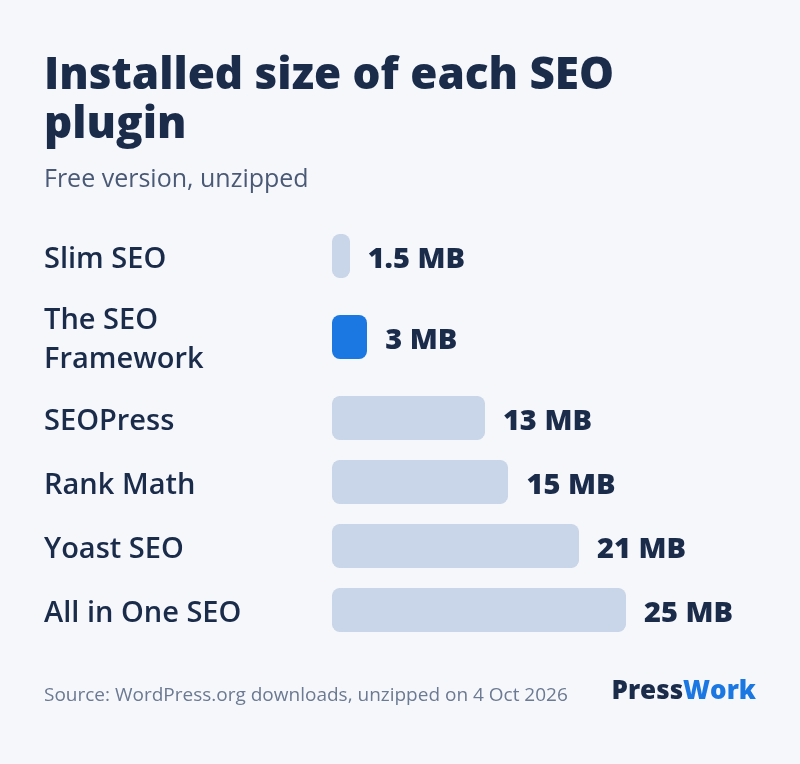
- The free plugin is 3 MB and 333 files. Yoast is 21 MB and 1,938 files.
- No release on WordPress.org since 10 December 2025, and paid extensions start at $7 a month for 2 sites.
This review uses public data only: WordPress.org, the plugin’s code, its pricing page, an independent speed test and our own scan of the top 10,000 sites. For the record, this site runs Rank Math, and we have no affiliate deal with any SEO plugin.
The SEO Framework at a glance
| Made by | Sybre Waaijer (CyberWire B.V.) |
| On WordPress.org since | May 2015 |
| Active installs | 200,000+ |
| Rating | 4.9 from 379 reviews (1.1% one-star) |
| Support threads resolved | 3 of 8 in the last 2 months |
| Current version | 5.1.4, released 10 December 2025 |
| Tested up to | WordPress 6.9 (the current WordPress is 7.1.2) |
| Installed size | 3 MB, 333 files |
| Paid plans | $7 to $27 a month, paid yearly (2 to 200 sites) |
What you get for free
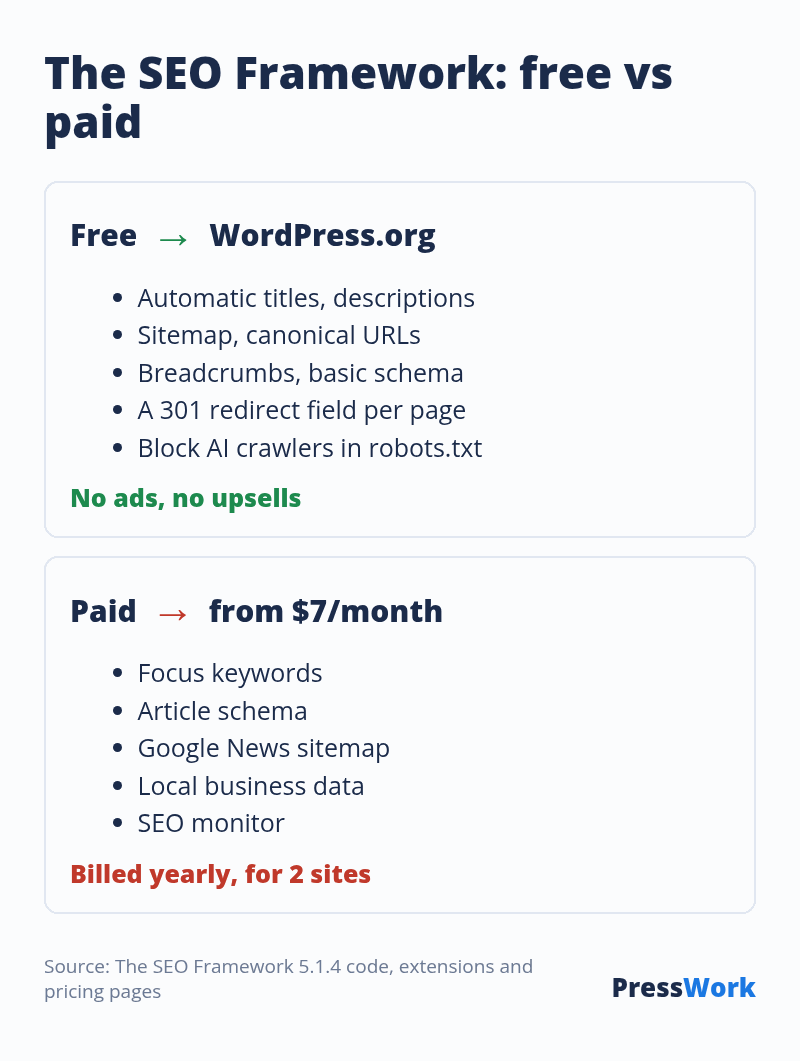
The free plugin sets up your SEO on its own and has no paid tier. Its readme answers “Is there a premium version?” with “No”. In the code of version 5.1.4 we found:
- automatic titles and meta descriptions for every page, which you can override one by one
- a sitemap, canonical URLs, and Open Graph and Twitter Card tags
- schema for the site, each page, breadcrumbs, the organization and the author, plus a breadcrumb shortcode
- a “301 Redirect URL” field on every post, page and category
- a setting that blocks AI crawlers such as GPTBot in robots.txt
- no upgrade prompts: we searched the code for them and found none
What is missing: there is no llms.txt and no IndexNow in the code. There is no redirect manager and no 404 monitor either. The readme says 404 tracking is left out on purpose, because it “must be done from the outside”. Focus keywords are left out of the free plugin too.
What costs money
Extras come as extensions, through a free companion plugin called Extension Manager. Of the 11 extensions, 5 are free and 6 are paid.
| Extension | Price | What it does |
|---|---|---|
| Focus | Paid | Focus keywords, with synonyms and inflections |
| Articles | Paid | Article schema and a Google News sitemap |
| Local | Paid | Local business information |
| Monitor | Paid | Tracks your site’s SEO from outside |
| Cord | Paid | Connects Google Analytics and Meta Pixel |
| Honeypot | Paid | Catches comment spam |
| Transport | Free | Migrates data from Yoast, Rank Math and SEOPress |
| Incognito | Free | Removes the plugin’s comments from your page code |
| Origin | Free | Redirects attachment pages to the parent post |
| Title Fix | Free | Fixes titles when a theme outputs them wrong |
| AMP | Free | Links the plugin to the AMP plugin |
The paid part is narrow. Rank Math gives focus keywords, Article schema and a local SEO module away for free. If you want those, The SEO Framework is the more expensive choice.
Price: $84 a year for 2 sites
Paid plans unlock every extension, and they are billed yearly. The cheapest one covers 2 sites, not 1.
| Plan | Sites | Price, paid yearly |
|---|---|---|
| Free | Unlimited | $0 |
| Pro | 2 | $7 a month ($84 a year) |
| Business | 20 | $17 a month ($204 a year) |
| Agency | 200 | $27 a month ($324 a year) |
For comparison, SEOPress PRO costs $49 a year for 1 site and $149 for unlimited sites. AIOSEO renews at $99 a year for 1 site. Yoast SEO Premium costs €118.80 a year per site. Rank Math PRO costs €8.99 a month, billed yearly.
Speed: half the time of Yoast and Rank Math
The SEO Framework is the second-fastest of the six SEO plugins Accelera timed, behind Slim SEO. Accelera ran them on a clean WordPress install (full test; published July 2024 with The SEO Framework 5.0.6, updated September 2026):
| Plugin | Visitor page | Admin | Editor |
|---|---|---|---|
| The SEO Framework | 35 ms | 6 ms | 20 ms |
| Rank Math | 69 ms | 73 ms | 96 ms |
| Yoast SEO | 71 ms | 95 ms | 177 ms |
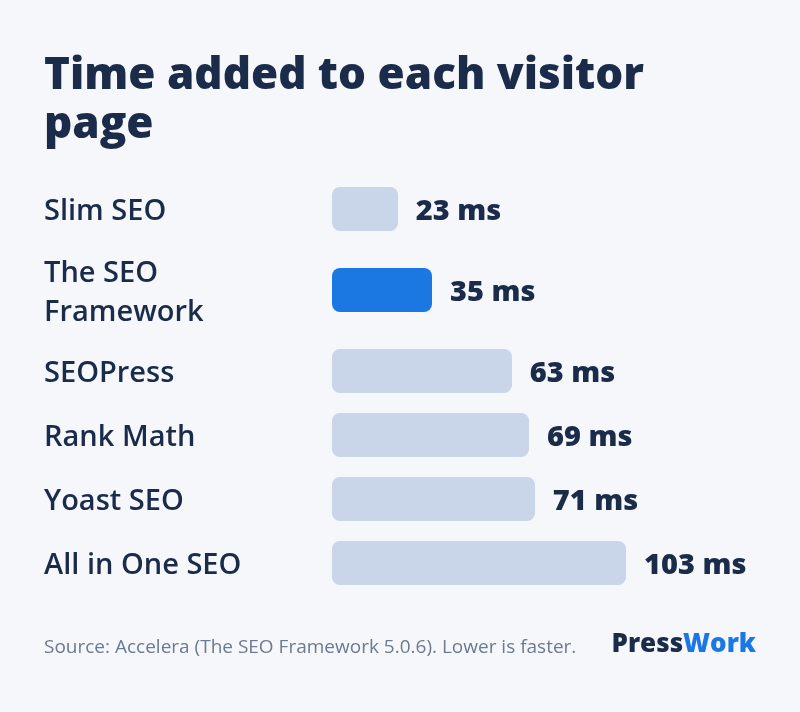
The gap is widest in the admin. The dashboard took 6 ms with The SEO Framework and 95 ms with Yoast. Slim SEO, the one faster plugin, took 23 ms per visitor page and 13 ms in the dashboard. In the post editor, The SEO Framework loads 22.4 KB of JavaScript, against 190 KB for Rank Math and 678 KB for Yoast. On fast hosting you won’t feel the 35 ms. On cheap shared hosting, with other plugins, it adds up.
The plugin is small on disk too. We unzipped the current free version of each plugin on 4 October 2026.
The warning: no release in almost 10 months
Version 5.1.4 came out on 10 December 2025, and WordPress.org has had no release since. Its listing says “tested up to 6.9”, while WordPress is now at 7.1.2. Yoast, Rank Math, SEOPress and AIOSEO each shipped an update in the last two weeks.
The project is not abandoned. Its public code repository had a commit on 3 October 2026. But the WordPress.org page lists one contributor, and 3 of the 8 support threads from the last 2 months are marked resolved. If you run client sites, weigh that.
Who uses it?
On 29 September 2026 we scanned the homepages of the top 10,000 sites in the Tranco ranking. Of 716 WordPress sites, 323 showed Yoast, 74 Rank Math, 19 AIOSEO and 5 The SEO Framework. We re-checked all five by hand on 4 October 2026: Ars Technica, Purdue University, Grab, Vivaldi and Toluna. You can check any site with our plugin detector.
It is easy to spot, because the plugin prints its name in a comment in the page code. The free Incognito extension removes that comment, so our count can miss sites.
Switching to and from The SEO Framework
- From Yoast, Rank Math or SEOPress: the free Transport extension moves titles, descriptions, social fields, canonical URLs and robots settings. It does not move focus keywords, or redirects from Yoast and Rank Math. Its page says support for AIOSEO is “coming soon”.
- To Yoast: Yoast 28.6 has an importer for The SEO Framework. It copies each post’s title, description, noindex, nofollow, canonical URL and social fields.
- To SEOPress: SEOPress 10.3 imports the same fields, plus the per-post redirect.
- To Rank Math or AIOSEO: we found no importer for The SEO Framework in Rank Math 1.0.279 or AIOSEO 5.0.2.1.
Pros and cons
- Pro: half the processing time of Yoast and Rank Math in Accelera’s test
- Pro: 3 MB installed, with no ads or upgrade prompts
- Pro: comes preconfigured, and rated 4.9 from 379 reviews
- Con: no release on WordPress.org since 10 December 2025
- Con: focus keywords, Article schema and local SEO are paid
- Con: no redirect manager, 404 monitor, llms.txt or IndexNow
- Con: Rank Math and AIOSEO can’t import its data
Should you use The SEO Framework?
- Yes, if speed comes first and you know the SEO basics. Add the free Redirection plugin for redirects.
- Yes, if you want a quiet dashboard. It shows no ads, scores or upgrade prompts.
- No, if you want keyword guidance for free. Rank Math and Yoast both include it.
- No, if you need frequent updates or a team behind the plugin. See the best SEO plugins for WordPress.
What to do next
- Try it on a staging site first, or in WordPress Playground, which the plugin’s page links to.
- Coming from Yoast, Rank Math or SEOPress: back up, install Extension Manager, run Transport, check 5 pages.
- Need redirects: add the free Redirection plugin.
- Check the “Last updated” date on its WordPress.org page before you put it on a client site.
See what a competitor runs
Paste any address into our free plugin detector to see its SEO plugin, theme and every plugin that loads on the page.
FAQ
Is The SEO Framework free?
Yes. The free plugin covers titles, descriptions, a sitemap, canonical URLs, social tags, breadcrumbs and basic schema, with no ads. Paid extensions such as focus keywords and local SEO start at $7 a month, paid yearly, for 2 sites.
Is The SEO Framework better than Yoast?
On speed, yes: it added 35 ms to each visitor page against 71 ms for Yoast in Accelera’s test, and it is 3 MB installed against 21 MB. Yoast is better on writing guidance and updates: Yoast was updated in September 2026, The SEO Framework in December 2025.
Is The SEO Framework still maintained?
Its last release on WordPress.org is version 5.1.4, from 10 December 2025, tested up to WordPress 6.9. Its public code repository had a commit on 3 October 2026, so work continues, but no new version has shipped since.
Does The SEO Framework have focus keywords?
Not in the free plugin. Focus keywords come with the paid Focus extension. The plugin’s readme says they are left out on purpose, because of Google’s warning about keyword stuffing.
Can I move from Yoast or Rank Math to The SEO Framework?
Yes. The free Transport extension moves titles, descriptions, social fields, canonical URLs and robots settings from Yoast, Rank Math and SEOPress. It does not move focus keywords, or redirects from Yoast and Rank Math.